

.svg)


.svg)


Hair loss affects more than just your appearance—it can change how you feel about yourself. You may try new hairstyles to cover thinning areas or feel self-conscious in social situations. Both men and women deal with hair loss, but the causes and patterns are different. What works for one person may not work for another. At Radiant Dermatology & Aesthetics, we tailor each plan to the individual. We determine the exact type of hair loss and then create a strategy to help restore your hair and your confidence.
The Importance of Precise Diagnosis
You can’t treat a problem until you know what it is. We begin by finding the exact cause of your hair loss. For men, the most common reason is Androgenetic Alopecia, also known as male-pattern baldness, which is usually caused by genetics.
For women, hair loss can have several causes. We check for Androgenetic Alopecia, but we also look for Alopecia Areata, an autoimmune condition where the body attacks its own hair follicles, causing sudden patches of hair loss.
We also check for Telogen Effluvium, which is often triggered by stress or illness. Traction Alopecia is another common problem, caused by tight hairstyles like braids or ponytails that pull on the roots and can damage follicles over time. Frontal Fibrosing Alopecia, which affects postmenopausal women, causes scarring at the hairline. We identify these specific causes before recommending any treatment.
Visualizing the Differences
The way hair loss appears can reveal important information.
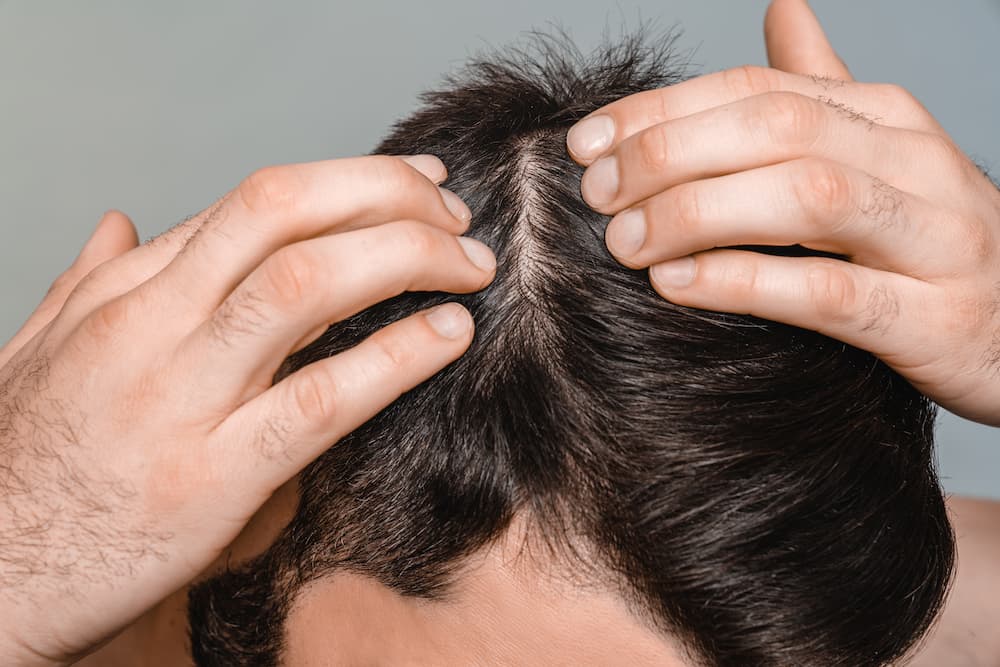
Male Patterns Men usually see a receding hairline first. The hair thins at the temples. A bald spot may form at the vertex, or crown. We use clinical scales to track this progression.
Female Patterns Women rarely develop a receding hairline unless they have Frontal Fibrosing Alopecia. Instead, women experience diffuse thinning. The part line widens. The scalp becomes visible through the hair on top of the head. The frontal hairline usually stays intact. This difference means surgical planning must differ between sexes.
Targeted Solutions: Prescription and Intervention
At Radiant Dermatology & Aesthetics, we group treatments into different categories and choose the right level of treatment based on how severe your condition is.
Prescription therapy may be the first step, as medications are less invasive than surgery.
- Topical Compounds: Minoxidil helps both men and women. It stimulates blood flow to the scalp.
- Oral Medications: Finasteride is common for men. It blocks the hormone responsible for shrinking follicles. We also use spironolactone. This helps women with hormonal imbalances.
- Steroids: Oral steroids can help stop the inflammation associated with patchy hair loss.
Advanced intervention therapies use newer methods that work at the cellular level, going beyond daily medications.
- PRP Therapy: We use Platelet-Rich Plasma. We draw your blood and isolate the healing platelets. We inject them into the scalp. This stimulates new growth.
- Light Therapy: Medical-grade lights target the follicles. This energy boosts activity and strengthens existing hair.
- Transplants: We harvest hair from the back of the head. We graft it onto the thinning areas. This is a minimally invasive surgery.
Determining Your Candidacy
Not every treatment is right for everyone. We first check your overall health, and you need a healthy scalp to move forward with treatment.
Who qualifies? Good candidates are generally healthy. For transplants, you also need enough donor hair on the back or sides of your head.
Who does not qualify? Some conditions limit your options. For example, people with scarring alopecia usually cannot have transplants because scar tissue prevents the grafts from taking root. Active autoimmune disorders can also affect treatment. If your hair loss pattern is not finished, especially in younger patients, surgery may be too soon. We will always be honest if a treatment is not right for you.
Take the Next Step
You don’t have to live with hair loss. Medical advances can help you keep your hair and even regrow what you’ve lost. The team at Radiant Dermatology & Aesthetics is here to help patients in Avondale and nearby Texas areas. We’ll examine your scalp, find the cause, and create a plan just for you.
Image credit: // Shutterstock // Inside Creative House


.png)

.png)


